.png)
Every SaaS Platform Is Secretly a Data Platform
When founders talk about building a SaaS company, the conversation usually revolves around product, engineering, customers and growth. Data is often treated as infrastructure. Something you worry about later. That is a mistake. Every successful SaaS platform is, whether its founders realise it or not, a data platform.
The moment your product stores information, synchronises with another application, powers dashboards, triggers workflows, personalises experiences or trains AI, your competitive advantage becomes inseparable from your data.
The irony is that many SaaS companies spend years perfecting their product while quietly building one of the most complicated data engineering problems in their business.
The hidden product nobody planned to build
Imagine a typical B2B SaaS startup.
It begins simply enough.
- A PostgreSQL database.
- A handful of APIs.
- Stripe.
- HubSpot.
- Maybe Salesforce.
- A warehouse in BigQuery or Snowflake.
- Some dashboards in Power BI or Looker.
Fast forward two years. Now there are hundreds of tables. Thousands of transformations. Customer-specific integrations. Scheduled jobs. Monitoring scripts. Documentation that nobody updates. Dashboards that don't agree with each other. And somewhere in Slack...
"Why has yesterday's revenue dropped by 40%?"
The answer is rarely the business. It's usually a broken pipeline.
Your engineers didn't sign up for this
One of the biggest costs isn't cloud infrastructure. It's opportunity cost. Highly paid software engineers end up fixing ETL jobs. Data analysts spend Monday mornings tracing missing records instead of generating insights. Product managers wait days for metrics they need today. The engineering team slowly becomes the custodians of pipelines rather than builders of products.
Nobody starts a SaaS company because they dream of maintaining data pipelines. Yet thousands of startups accidentally hire teams whose primary responsibility becomes exactly that.
AI is making the problem worse
AI features have changed the equation. Every new AI capability depends on trustworthy data.
- Context.
- Metadata.
- Customer history.
- Product usage.
- Events.
- Permissions.
- Documents.
If the underlying data is unreliable, the AI simply produces unreliable answers faster. Companies are rushing to build AI-powered products while quietly accumulating technical debt underneath. The smarter the AI becomes, the more important clean, governed data becomes.
Every product has an operating system
Think about modern operating systems. You don't manually allocate memory. You don't schedule CPU threads. You don't manage every hardware interaction yourself. The operating system quietly coordinates everything.
Data should work the same way. Instead of treating every pipeline as a separate engineering project, imagine an operating system dedicated to your data. One that understands the project. Shares context between every process. Automatically generates documentation.
Schedules work. Builds pipelines. Tests them. Deploys them. Monitors them. Repairs failures before anyone notices.
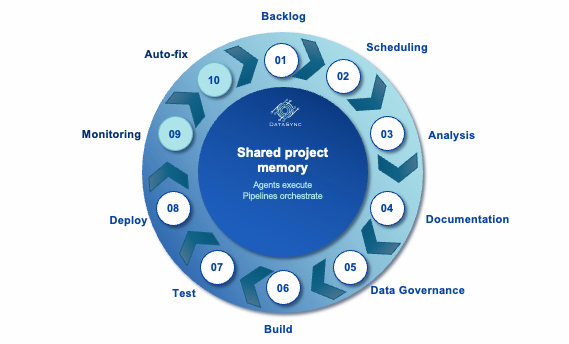
That is exactly how we think about DataSync. The shared project memory sits at the centre, allowing specialist AI agents to work together rather than in isolation.
From backlog planning through scheduling, analysis, documentation, governance, build, testing, deployment, monitoring and even self-healing, every stage shares the same understanding of your data estate. The result isn't another ETL tool. It's an operating system for data projects.
(The diagram below illustrates this concept.)
The future isn't bigger data teams
For years, scaling meant hiring.
Need another integration? Hire a data engineer.
Need better reporting? Hire a data analyst.
Need governance? Hire another specialist.
That model is beginning to break. Just as AI is transforming software development, it's transforming data engineering. The future isn't replacing experts. It's allowing experts to spend their time solving genuinely difficult problems instead of maintaining fragile infrastructure. Your analysts should analyse. Your engineers should build products. Your product managers should make decisions. Not chase broken pipelines.
Every SaaS company should ask itself one question
If your data pipelines disappeared tomorrow, could your product still operate? For almost every SaaS business, the answer is no. Your billing stops. Your AI stops. Your customer reporting stops. Your internal metrics stop. Your automations stop. That's because your data platform isn't supporting your product. It is your product.
The companies that recognise this early will move faster, ship more features and spend less time maintaining invisible infrastructure. The companies that don't will continue hiring engineers to fight yesterday's problems.
At DataSync, we're building AI agents that replace much of the manual work involved in building, managing and repairing data pipelines. Our goal isn't to replace your engineers or analysts—it's to remove the repetitive engineering work that prevents them from focusing on what creates value: building exceptional products and helping customers succeed.
Get started with DataSync today
Give your next data project a team that remembers. Start free with your own data, or book a walkthrough and see the platform against a sample of it.